

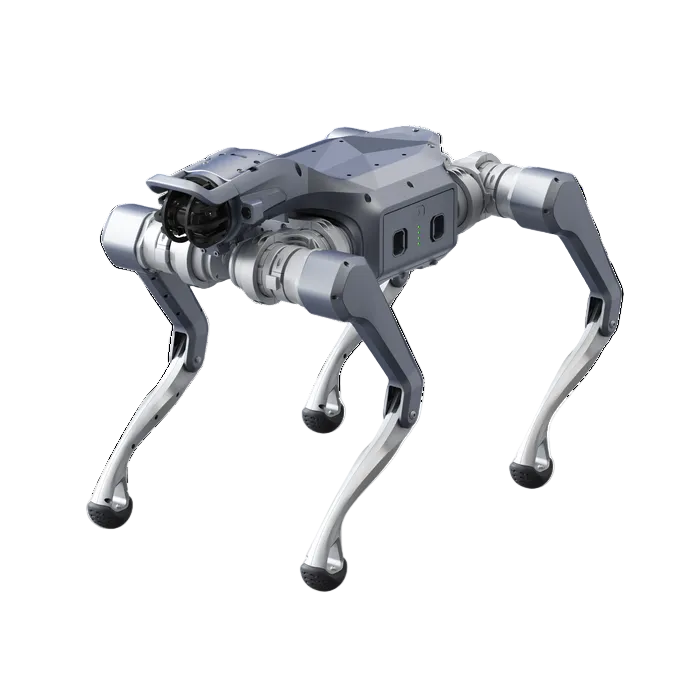
Unitree AS2 EDU Research Quadruped
Open-platform industrial quadruped robot for research and development. 90 N·m torque, 5+ m/s speed, 65 kg standing payload, 4+ hour runtime, IP54 rated. Optional NVIDIA Jetson Orin NX compute.
Free Shipping, fulfilment within 1-2 Weeks
Choose options
Unitree AS2 EDU Research Quadruped
product.price.sale_price
$15,000.00 AUD
Product Description
The Unitree AS2 EDU is Unitree's open-platform industrial quadruped robot, engineered for research institutions, developers, and enterprise innovation teams building and deploying autonomous robotics solutions. Weighing just 18 kg, the AS2 combines high explosive power in a compact body — up to 90 N·m of peak joint torque (roughly double its predecessor, the Go2), speeds over 5 m/s, and the ability to carry a 65 kg standing load or approximately 15 kg continuous payload while navigating uneven terrain.
The AS2 EDU is designed as a fully open platform for secondary development, giving teams complete flexibility to integrate sensors, AI models, and custom payloads — bridging the gap between lab research and real-world field deployment. It handles stairs, 40° slopes, and rough terrain with ease, delivers over 4 hours of runtime unloaded (20+ km range) or 2.5+ hours with a 15 kg payload (13+ km range), and carries an IP54 rating for dust and light rain resistance. Onboard LiDAR, HD camera, front lighting, an 8-core CPU, and ISS 3.0 enable centimetre-level person following, autonomous navigation, and gesture-based control, with optional NVIDIA Jetson Orin NX compute for advanced AI and perception workflows.
Key Specifications
- Weight: ~18 kg (with battery) | Dimensions: 720 × 378 × 457 mm (standing)
- Degrees of Freedom: 12 (3 actuated joints per leg)
- Peak Joint Torque: ~90 N·m | Max Speed: 5+ m/s
- Payload: 65 kg standing / ~15 kg continuous walking
- Battery: 648 Wh | Runtime: 4+ hours unloaded / 2.5+ hours loaded
- Range: 20+ km unloaded / 13+ km with 15 kg payload
- Terrain: 40° slopes, 25 cm steps, stairs, uneven ground
- Protection: IP54 (dust and light rain resistant)
- Sensors: LiDAR, HD camera, front lighting, 8-core CPU, ISS 3.0 person following
- Compute: Optional NVIDIA Jetson Orin NX for AI development
- Development: Open SDK/APIs, full secondary development support
- Use cases: Industrial inspection, security patrol, logistics, emergency response, AI research